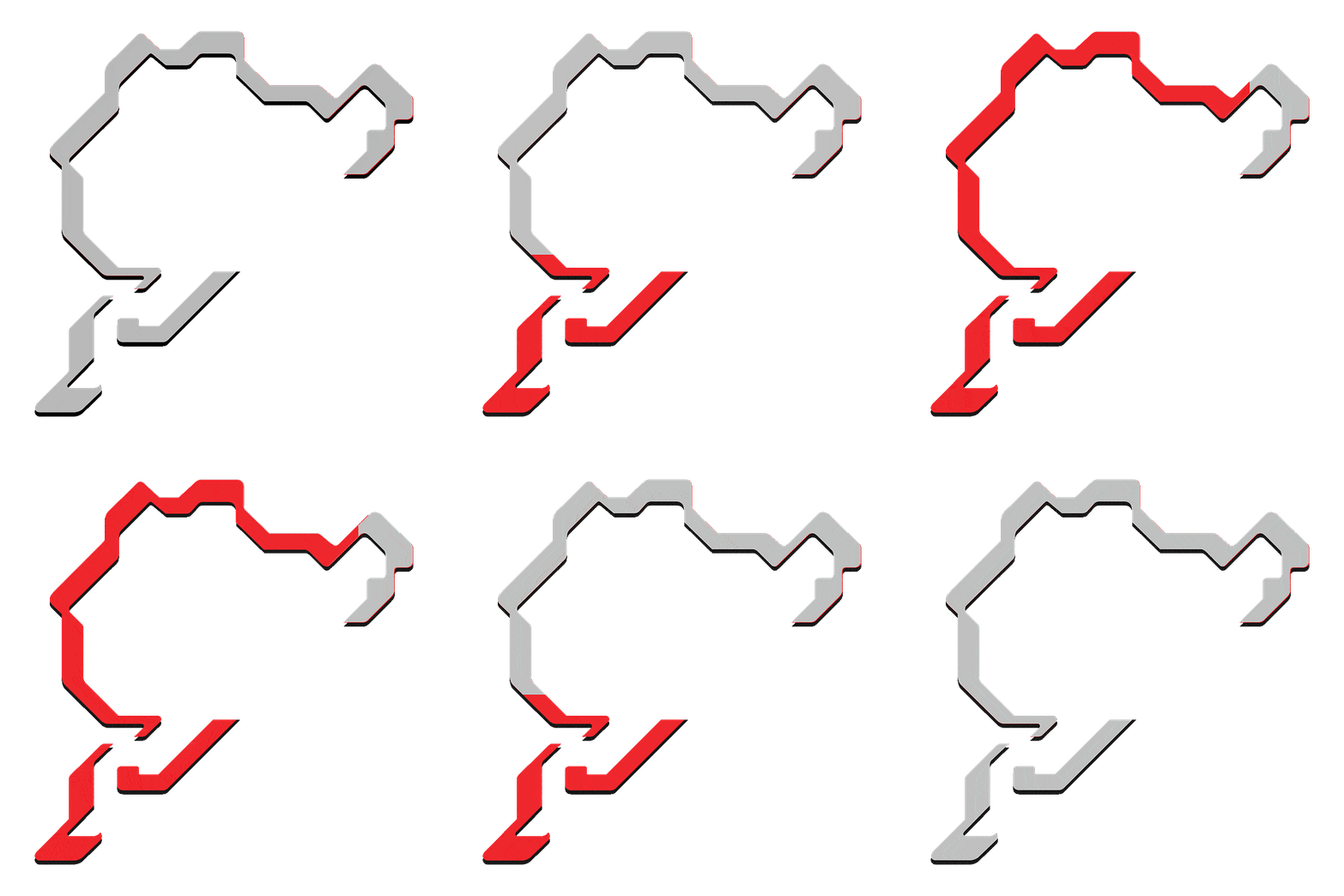


When the motorsports season ends at the Nürburgring, the peak season for construction equipment begins. The operating company will once again be making extensive investments in the maintenance of its two race tracks during the winter of 2026/2027. Approximately two million euros will be allocated to the resurfacing of a total of about 24,000 square meters of asphalt on the Nordschleife and the Grand Prix circuit. The focus is on several sections of the track: the Galgenkopf, the Döttinger Höhe, the Hatzenbach, and the Falkenbogen. The goal of this regular maintenance is to keep the race tracks at a consistently high technical and safety standard while preserving the unique character of the Nordschleife.
On the legendary Nordschleife, the most extensive work is concentrated in the Galgenkopf and Döttinger Höhe areas. In total, the work here covers a length of 1.6 kilometers. Another area undergoing renovation is Hatzenbach, where approximately 100 meters of asphalt will be replaced. The Grand Prix circuit will also receive new asphalt this winter. In the Falkenbogen area, the track surface is being resurfaced over a total length of approximately 500 meters.
The winter construction projects are part of a long-term maintenance strategy. On average, about one kilometer of the Nürburgring racetrack is renewed each year to ensure it continues to meet a wide range of requirements in the future: from international motorsports and tourist drives to track days, as well as test and development runs for the automotive and supplier industries.
The Nordschleife’s distinctive character will be preserved
In addition to the quality of the track surface, all work focuses in particular on preserving the unique character of the Nordschleife. Its challenging layout, featuring numerous curves, crests, and elevation changes, has made it one of the world’s most famous race tracks for nearly 100 years. These characteristics will be preserved even during extensive renovations.
“Our race tracks are a crucial foundation for the Nürburgring’s success. In this regard, we are investing in the heart of the Nürburgring—in the quality of the race tracks and their infrastructure,” explains Alexander Schnobel, long-time project manager for construction work at the Nürburgring. “The goal is not to alter the Nordschleife through construction work, but to preserve its unique character while simultaneously meeting the high technical and safety requirements of a modern racing and test track on a long-term basis.”
Schnobel has been involved in the infrastructural development of the Nürburgring for about 25 years. In addition to regular asphalt work, he has also driven forward forward-looking projects during this time, such as the comprehensive digitization of the Nordschleife.
Continuous Modernization of the Race Tracks
For years, investments in the Nürburgring have gone beyond simply renewing the track surface. One example is the approximately 11 million euro digitization of the Nordschleife. With around 100 cameras, modern warning panels, and an extensive digital infrastructure, events on the approximately 21-kilometer-long track can now be comprehensively monitored, and track users can be warned of hazards at an early stage.
The Grand Prix circuit has also undergone technical modernization in recent years. This includes, among other things, the completely newly built Race Control center, from which track operations can be centrally monitored and coordinated.
With regular winter construction work and the ongoing modernization of its infrastructure, the Nürburgring is creating the conditions for safe and reliable track operations. At the same time, this ensures the long-term competitiveness of this historic motorsports and business hub.
Next year, the Nürburgring will celebrate its 100th anniversary. The continuous maintenance and further development of its race tracks ensure that the unique combination of tradition and state-of-the-art technology will be preserved well into the future.
An overview of recent years (total since 2015: ~33 million euros):
| 2025 / 2026: 2 Mio. Euro |
Neuer Asphalt Galgenkopf, Döttinger Höhe und Hatzenbach (Nordschleife) sowie Falkenbogen (Grand-Prix-Strecke) |
| 2024 / 2025: 2,5 Mio. Euro |
Neuer Asphalt Pflanzgarten und Kesselchen; zusätzliche Ausfahrt für Touristenfahrer an der Döttinger Höhe; Instandhaltung der Grand-Prix-Strecke und des Fahrerlagers |
| 2023 / 2024: 3 Mio. Euro |
Neuer Asphalt Fuchsröhre (Nordschleife) Ausfahrt Boxengasse (Grand-Prix-Strecke) & Fortsetzung des 11 Millionen Euro Projektes „Digitalisierung Nordschleife“ |
| 2022/2023 - 2024/2025: 11 Mio. Euro |
Digitalisierungsmaßnahme Nordschleife 4K-Streckenkameras, Glasfaser, Stromversorgung rund um gesamte Nordschleife & Entwicklung künstlicher Intelligenz |
| 2021/2022: 3 Mio. Euro |
Neuer Asphalt Döttinger Höhe (Nordschleife) bis Hyundai N Kurve (Grand-Prix-Strecke) 300 Meter neuer FIA-Fangzaun zwischen Kallenhard und Wehrseifen |
| 2020/2021: 1 Mio. Euro |
Digitalisierungs-Projekt für Teile der Nordschleife 4K-Streckenkameras & Glasfaser von Döttinger Höhe bis Hohenrain Schikane |
| 2019/2020: 1 Mio. Euro |
Neuer Asphalt AMG Arena (Grand-Prix-Strecke) Neubau Nürburgring Rallycross-Strecke Weitere Infrastruktur-Maßnahmen Müllenbachschleife |
| 2018/2019: 1,3 Mio. Euro |
Umfangreiche Digitalisierung der Grand-Prix-Strecke 4K-Streckenkameras, 17 Kilometer neue Glasfaserkabel Rundum erneuerte Race Control |
| 2017/2018: 4 Mio. Euro |
Neuer Asphalt Schwedenkreuz, Kallenhard, Wehrseifen & Ex-Mühle Weitere FIA-Fangzäune an der Nordschleife |
| 2016/2017: 1 Mio. Euro |
Neuer Asphalt Hatzenbach, Hohe Acht, Hedwigshöhe & Brünnchen FIA-Fangzäune u.a. Hatzenbach & Kesselchen |
| 2015/2016: 2 Mio. Euro |
Neuer Asphalt Quiddelbacher Höhe & Flugplatz Neue FIA-Fangzäune u.a. Schwedenkreuz, Metzgesfeld, Stefan-Bellof-S Informations-Anzeigetafeln Nordschleifen-Zufahrt |
| 2014/2015: 1 Mio. Euro |
Neuer Asphalt im Bereich Eschbach Asphaltarbeiten auf und neben der Grand-Prix-Strecke |